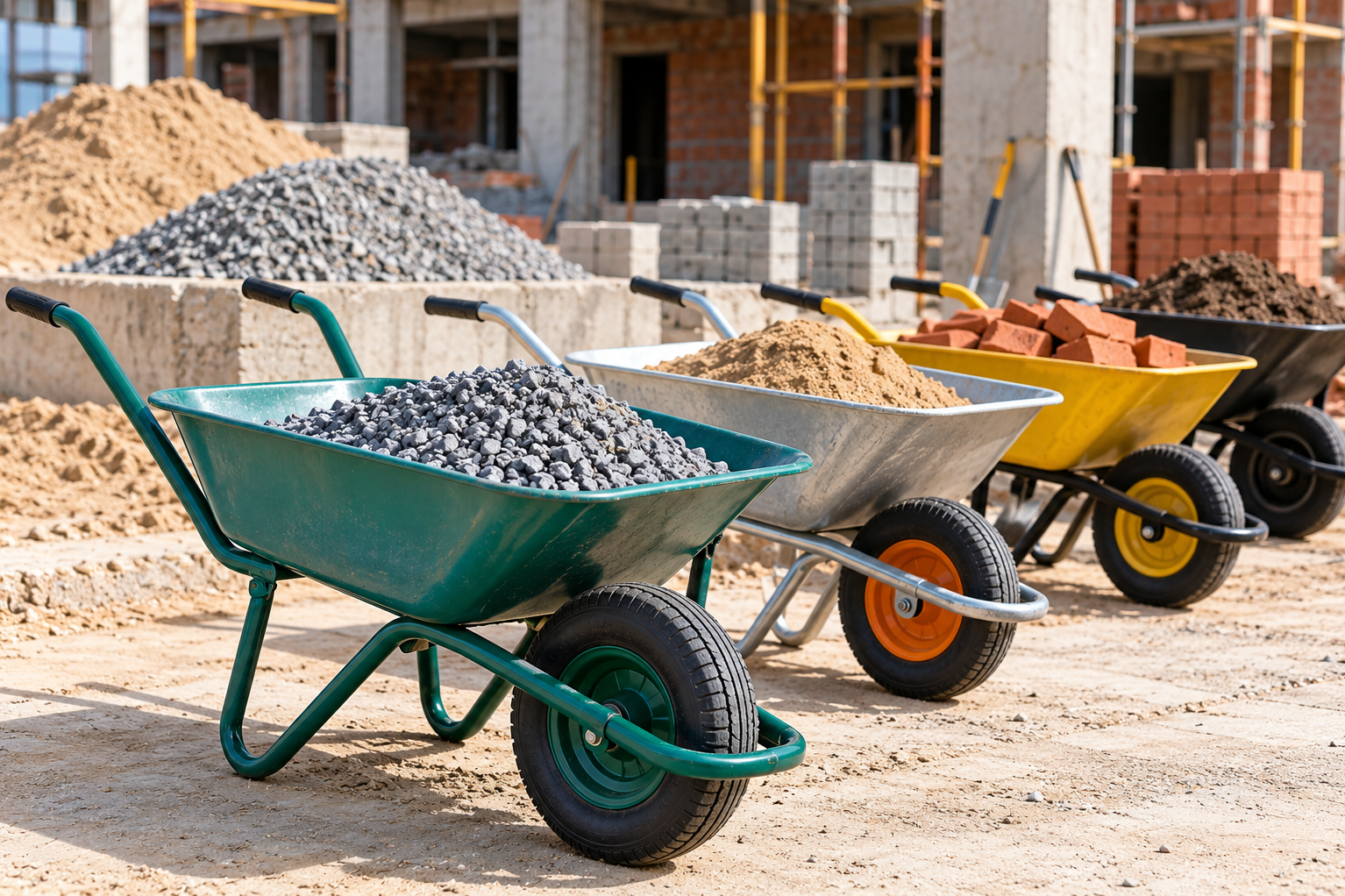
Some of the simplest equipment on a construction site can have a surprisingly large effect on daily productivity. A Wheel Barrow is used repeatedly for moving concrete, sand, aggregates, debris, soil, tools, and other materials over short distances. Because it appears straightforward, procurement teams sometimes treat every wheelbarrow as interchangeable.
In reality, construction use places considerable stress on the tray, frame, wheel, handles, and supporting structure. Choosing equipment based on actual site conditions can reduce unnecessary handling difficulties.
Consider What Will Be Carried
Start with the material rather than the wheelbarrow.
A unit regularly carrying dense construction materials faces different demands from one primarily used for garden soil or lightweight debris.
Typical construction applications include moving:
- Sand
- Aggregate
- Concrete
- Bricks
- Excavated soil
- Demolition debris
- Tools
- Packaged materials
The intended load influences the tray and frame requirements.
Examine Site Surfaces
Construction sites rarely provide smooth routes.
Wheelbarrows may need to travel over compacted soil, temporary paths, uneven ground, ramps, or partially completed surfaces. Wheel characteristics therefore matter because they influence maneuverability and operator effort.
Project managers should consider the actual route between material storage and the working area.
Look at Tray Construction
The tray experiences repeated impact and abrasion.
Its size should provide useful carrying capacity without making the loaded wheelbarrow unnecessarily difficult to control. Larger capacity is only beneficial when workers can safely and practically handle the resulting load.
Durability is particularly important when abrasive materials are moved frequently.
Inspect the Frame
The frame supports the load and transfers it toward the wheel and handles.
For construction applications, check how the tray is supported, the general rigidity of the frame, fastening points, and the quality of fabrication.
Procurement teams buying multiple units should inspect consistency across the batch rather than assessing only one sample.
Avoid Overloading
A wheelbarrow can physically hold more material than an operator should reasonably move.
Overloading increases handling difficulty and can place additional stress on the equipment. The appropriate load depends on the product specification, material density, terrain, and working conditions.
Site supervisors should encourage controlled loading rather than treating maximum volume as the target for every trip.
Small Productivity Improvements Add Up
Imagine a masonry or concreting crew making dozens of short material movements during one shift.
A poorly balanced or damaged wheelbarrow makes every trip slightly more difficult. Across multiple workers and several months of construction, these small inefficiencies accumulate.
That makes wheelbarrows a basic but worthwhile part of equipment planning.
For builders and contractors operating around Nagpur, seasonal site conditions can also change travel surfaces. Dry loose soil during one period may become wet or uneven during another, so robust equipment can be valuable across changing project conditions.
Ovi Enterprises supplies construction machinery and site equipment for contractors with varied requirements across Maharashtra. When purchasing wheelbarrows in quantity, buyers can discuss expected materials, site usage, and durability requirements rather than making the decision solely on unit price.
A good wheelbarrow does not need complicated technology. It needs to suit the load, terrain, operator, and frequency of use. Getting those fundamentals right supports smoother everyday material movement across active construction sites.
Keywords