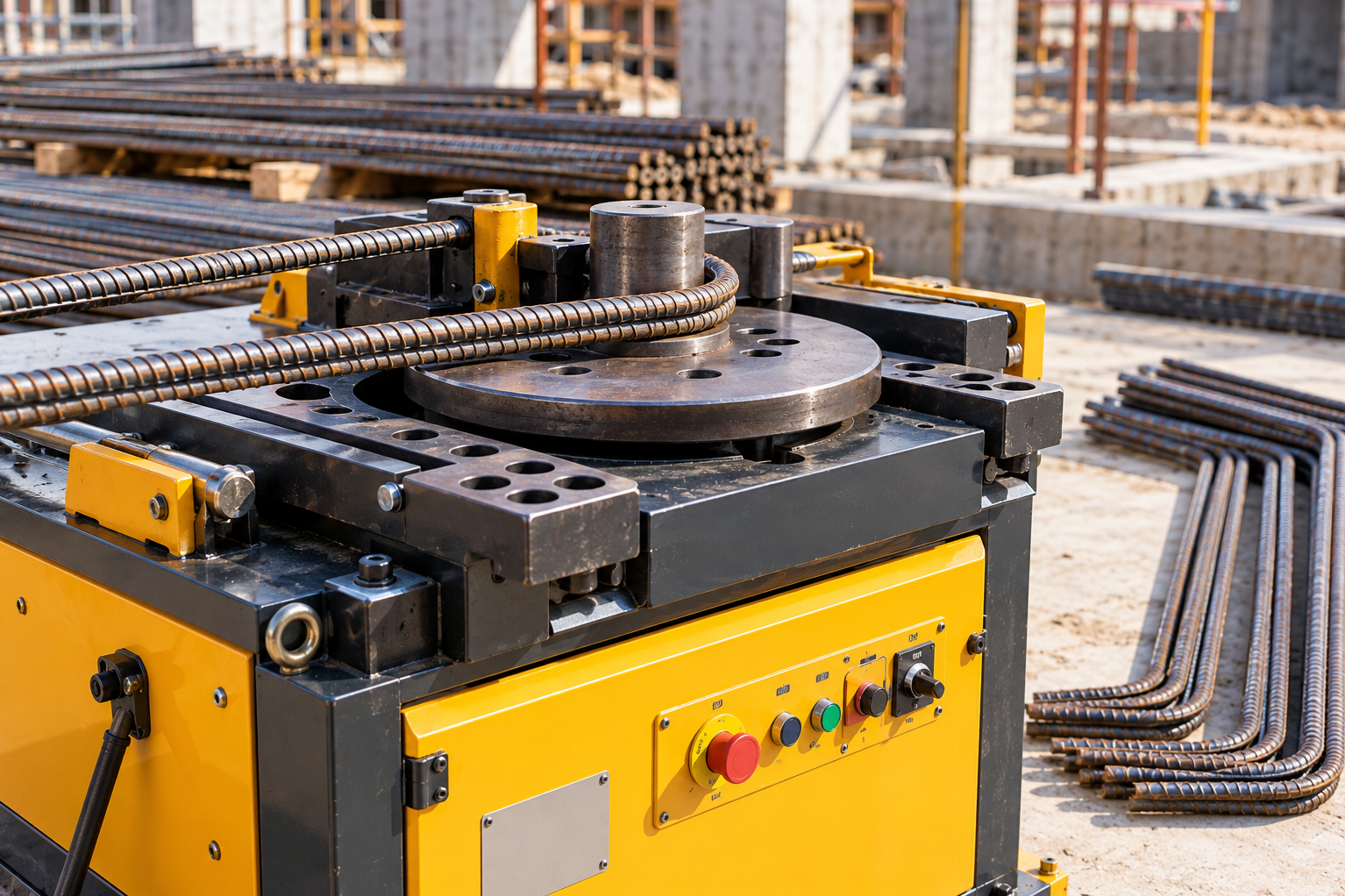
Reinforcement preparation is a repetitive but precision-sensitive activity on reinforced concrete projects. Bars must be bent to specified shapes and dimensions according to structural drawings and bar bending schedules. A Bar Bending Machine mechanizes this process, making it particularly relevant for contractors handling substantial volumes of reinforcement.
Before purchasing equipment, contractors should compare capacity, bar sizes, bending requirements, controls, workload, operator training, and serviceability.
Define the Reinforcement Range
The first question is straightforward: what bar sizes will the machine need to handle?
Projects can use multiple reinforcement diameters depending on structural requirements. Buyers should review current work plus likely future projects before choosing machine capacity.
Never assume that a machine can safely bend any reinforcement that physically fits into the working area. Manufacturer-specified capacity and operating instructions should be followed.
Consider Daily Bending Volume
A small building project may have very different reinforcement requirements from a major residential tower, industrial facility, infrastructure structure, or government project.
Estimate:
- Number of bends per day
- Typical bar diameter
- Common bend shapes
- Peak workload
- Number of operators
- Expected operating hours
This helps determine whether the proposed equipment is appropriate for the intended duty.
Evaluate Control Simplicity
Construction equipment is more productive when trained operators can use controls consistently.
Buyers should inspect the control arrangement, bending setup, adjustment process, and safety features. If multiple operators will use the machine, standardized training becomes important.
Clear operating procedures can also help reduce incorrect bends and unnecessary material handling.
Look at Work Area Requirements
A bar bending machine may occupy a relatively small footprint, but reinforcement bars can be long.
The surrounding working area therefore matters as much as the machine dimensions.
There should be sufficient room for feeding, positioning, bending, removing, and stacking reinforcement without creating unnecessary congestion.
On compact urban sites in Nagpur, planning the reinforcement fabrication zone can significantly improve workflow.
Assess Maintenance Access
Machines used regularly on construction sites need routine inspection.
Before buying, ask how commonly serviced components can be accessed, what maintenance is recommended, and whether relevant replacement parts are obtainable.
Rental companies should also consider how easily the machine can be inspected between customers.
Calculate Value Through Utilization
Mechanization makes the most economic sense when the machine has enough work.
Rather than comparing purchase price alone, procurement teams can consider:
- Expected project pipeline
- Labour involved in reinforcement preparation
- Required bending volume
- Machine utilization
- Maintenance
- Transportation
- Downtime risk
The calculation will differ for a builder purchasing for internal projects and a rental company purchasing equipment for external customers.
Construction equipment suppliers such as Ovi Enterprises can help buyers in Maharashtra discuss bar bending machine specifications according to reinforcement sizes and project workload.
A well-selected machine should support the reinforcement workflow without becoming a capacity bottleneck. Defining bar sizes, workload, site layout, operator requirements, and maintenance expectations before procurement gives contractors a much stronger basis for comparing available equipment.
Keywords